Tuesday, September 6, 2011

Spring is in the air...


Camellias are on show, the flowering quince (above) is coming to life, the scent of pink blossom fills the air. The more constant warmth invites you into the 'outdoor room'. One can only wax lyrical at this time of the year. 


However, on the down side, and yes there is usually a down side, the wandering jew (politically incorrect I believe) and the onion weed are rampant. Months of 'laissez faire' gardening is evident and there is a lot of work to be done. Despite this I'm sure that St Fiacre, patron saint of gardeners, is smiling and I have  a renewed enthusiasm and energy to fluff up the garden. Here are some more flower pics from Kallista for you.


Note the little bird in the weeping cherry


Monday, September 5, 2011

Fun Fungi!

                                                           I know, long time no blog!

It is easy to ignore the garden in winter as the rain and cold are not really conducive to spending much time in it. Regardless there are still lots of interesting things happening, including the appearance of diverse varieties of fungi (although apparently most reveal themselves in Autumn). Kallista (as in our house & garden) is in a very damp and dark situation, opposite a creek. This makes it a perfect environment for moisture seeking fauna and flora. Having said that fungi can be found in many diverse global habitats, including deserts.


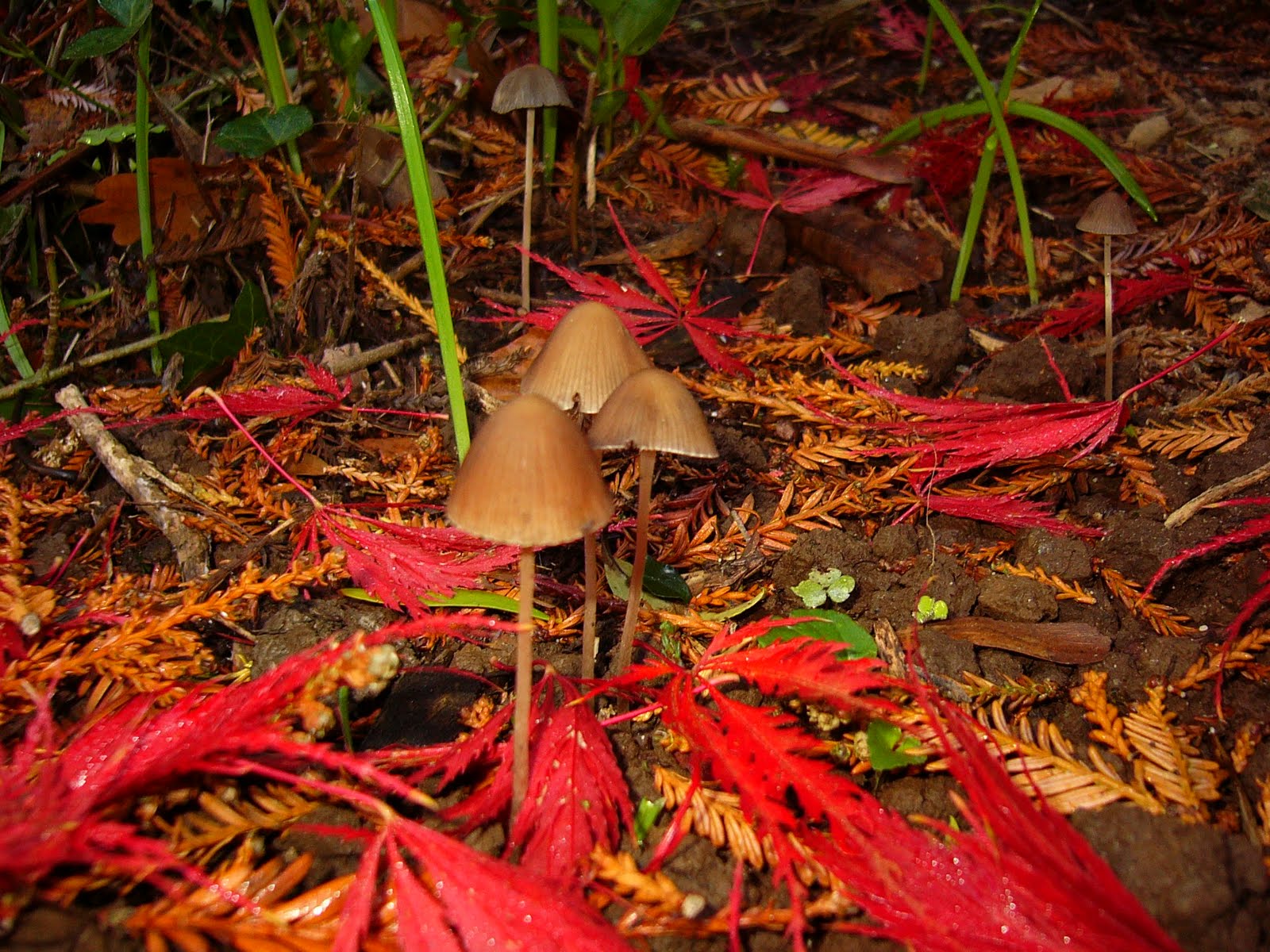
Here are some 'Fun Fungi that we located and thanks go to PK for some of these wonderful pics. 


Now, for a little background on these organisms. According to the "Australian National Botanical Gardens" website what you see in the garden is just the tip of the iceberg. Around 90% of the organism is underground and the part that you see on the surface has the function of producing and dispersing spores. The underground component, the mycelium, remains there throughout the year.


Fungi interact with other organisms, some in a parasitic fashion and others are beneficial to plants. As yet I haven't tried to identify ours and their relationship to their hosts except for this yellow one which I stumbled upon in the literature and our garden. It is most likely to be a Cytarria gunnii that enjoys the company of our Nothofagus (southern beech).


Saturday, April 30, 2011

More Autumn @ Kallista images


Went up to Kallista again on Thursday. The day was cool and the light only moderate however, the colour of most of the deciduous trees was more vivid than the week before. Here are some more images.


Copper beech


Monday, April 25, 2011

Autumn in the Hills

                 Autumn has arrived at Kallista. However, as is the case with gardens that have a variety of Autumn species not all the trees are at their best at the same time. Each week presents a new display of colour and this week most of the maples are showy, whereas the gingkos for example are still green. Today I'll just show you some of the maple colour and introduce you to Robbie, my truly excellent gardening companion.


Robbie at work

G.

Sunday, April 10, 2011

Ginger plants

Sorry for the delay in creating a new post but I became a little bored with the last one that I was writing (intermittently) and so I've decided to move on and publish what is new in the garden at present.

There is nothing more satisfying than something that grows easily from something pilfered in the neighbourhood!
I have always admired these plants and they are certainly abundant in many gardens of the Dandenongs. They have been in bloom recently and are wonderfully fragrant.
They produce a fragrance that is not overpowering and does not overwhelm you like the heady perfume of some gardenias can, more a gentle perfume that pervades the garden.

The specimen in this blog was seconded from the roadside at Kallista. It has had nothing but neglect and is flourishing.


Hmm...I'm often surprised when I actually research the plants in my gardens as it often leads to the questioning of my choice of plant. This plant variously known as: Hedychium Gardnerianum or Butterfly Ginger or Ornamental Ginger or Kahila Garland Lily is a class one weed! In fact it is one of New Zealand's worst rainforest weeds.

It is a perennial rhizamatous plant that grows to around 2 meters high. It is very hardy in many climates despite its tropical origins. The flowers are present from Summer into Autumn however the lush green foliage is present all year round.

This is obviously one plant that I need to keep in check. It is always the plants that grow beautifully and easily that attract the derogatory 'weed' label.


Friend or foe? I'll let you decide.
G.

Sunday, December 19, 2010

Time for tea, Gingko that is...

Gingko biloba (or Maidenhair tree) is the national tree of China and is the single living species of the Gingko genus, plants that evolved in an era before flowering plants. Moreover, Gingkos are of ancient origins with fossils found of them that date back to the early Jurassic period.  And hey...it's a plant growing at Kallista that isn't poisonous!

I have a Korean friend who was very excited when she discovered that I had a Gingko tree. Apparently the plants are very highly regarded in Asia for their medicinal qualities, particularly when you use their leaves to make tea or a tincture. Well, being the curious person that I am I had to give the tea a go, didn't I? After finding a recipe I proceeded to inspect my poor little trees; there are two. Again the usual story at Kallista whereby the plants have to compete with one and other for the basics in life and so both of these lovely little trees are probably a bit stunted in growth and are growing in unusual postures to find some light. So I thought. However after a little research I discovered that 'erratic' branches are not uncommon and gulp, they can grow as big as 35 metres.


Anyway, I made the tea (only a half quantity as I didn't want to denude the trees). Conclusion: I think that it is not an unpleasant taste but perhaps it is one where you have to convince yourself that the Gingko is doing you some good. I also tried a commercial tea which was of a green tea base and had 15% Gingko leaf as well as fennel, licorice, peppermint, cinnamon bark, vanilla and caramel flavours. This was far more exciting, if not therapeutic.


Gingko tea recipe: 
Add 1 cup of boiling water to 1 teaspoon of dried Gingko or 1 tablespoon (~5 leaves) of fresh Gingko. Sweeten as desired. (The tincture recipe had 500mls of vodka in it!)
But be warned. There are claims that Gingko will enhance your memory, ward off dementia and help your circulation however, there are also medical warnings regarding its anticoagulant and allergenic effects.


In Autumn the leaves of the Gingko tree turn bright yellow and are very pretty. So, when the time comes, I will include a picture of them along with the other spectacular deciduous trees. Now what was I saying? Yes, the Gingko biloba is great for your memory....
G.

Sunday, December 12, 2010

Yews

Wow...when you research specific plants the information that you uncover is always fascinating. In the case of Yew trees the human history and beliefs associated with them, as well as their use historically and in present day medicine is incredibly interesting. I will give a very brief introduction to Yew trees here and you may search the wonderful (if not always accurate) internet if you would like more substance.


Yew trees are conifers. They grow as a small to medium sized tree and, depending on what sources you use, they can be divided into two broad groups: European Yews and Pacific Yews. Some botanists would argue that they are all subspecies of the one widespread variety. At Kallista there are four yew trees. We believe them to be Irish yews (x2), one English yew and one Japanese yew. I am happy to stand corrected if anyone visits. There is an Irish yew in the centre of this photo and another behind, with a different type of conifer in between them. They are slow growing trees and are very long lived, although dating them is nigh impossible. This is because the central core of them deteriorates with age and so there are no central tree rings with which to assist in dating them.


The history that I found fascinating that I alluded to earlier is thus. Yew trees have long been in the human imagination. For example there are copious literary references to them as far back as 'Beowulf' and as recent as 'Harry Potter'. In Asturian (of Spanish, celtic origins) tradition Yew branches were taken to the tombs of the recently departed so that they would find their guide to the Land of the Shadows. It appears that this association promoted the planting of Yews in many churchyards and cemeteries especially in Great Britain.


Another point of historical interest was the use of mature Yew trees in the production of longbows in medieval England. Their springy wood was in such high demand for these weapons that it resulted in the depletion of these trees over vast areas. Yews were also sought after as many parts of these trees were used to treat various maladies. It is now known that all yews contain highly poisonous toxoids known as taxanes, and the refined products have been developed for use in chemotherapy. Deer are one of the few animals that can eat Yew and survive. Here endith the history lesson.


My experience with Yews at Kallista is minimal as we've only had the place for 6 years. Like most things in this garden the Yews define their own existence. The Japanese Yew struggles as it was planted in a very shady spot with lots of competition from other plants for light and nutrients, whereas the other varieties receive more sunlight and are far happier. I don't have a picture in my file of the small cones and pretty red berries that they produce but when they appear I will add one to the blog.
G.